At the 2025 International Union for Conservation of Nature (IUCN) World Conservation Congress in Abu Dhabi, Resilient Landscapes Luxembourg (RLL) convened a knowledge-sharing session on “Financing the Future: Unlocking Private Capital for a Thriving Planet.”
The session featured Luxembourg’s Minister of the Environment, Climate and Biodiversity, Serge Wilmes, who highlighted the innovative approach and tangible results of RLL — an initiative advancing high-quality, scientifically grounded, and financially viable nature-based solutions.
Abu Dhabi, 9 October 2025 — The Center for International Forestry Research and World Agroforestry (CIFOR-ICRAF), through its Resilient Landscapes program and with the support of the Government of Luxembourg, unveiled groundbreaking, science-driven solutions to accelerate investment in nature-based initiatives during a high-level session at the IUCN World Conservation Congress 2025.
The session, titled “Financing the Future: Unlocking Private Capital for a Thriving Planet,” explored strategies to address the intertwined climate and biodiversity crises by unlocking USD 4–5 trillion annually in private capital. While nature-based solutions (NbS) offer a triple win for climate resilience, biodiversity conservation, and human prosperity, perceived financial risks continue to limit large-scale investment.
Drawing on real-world projects across Benin, the Democratic Republic of the Congo, Nepal, and Rwanda, CIFOR-ICRAF and its partners showcased innovative approaches that create new investment opportunities, mitigate risk, and scale up sustainable finance mechanisms.
The session called on investors, policymakers, and practitioners to engage in shaping solutions, challenge conventional models, and contribute to a growing movement to mobilize private finance for nature.
Science is a key ingredient in ensuring evidence-based quality investments in Nature-based Solutions (NbS) to prevent climate change and biodiversity loss. Science also guides the design of innovative tools that support high-level impact ambitions and commitments by providing concrete scientific evidence and solutions to those global challenges. While the relationship between science and business has been evolving, there is still a need to improve the dialogue between the two fields to create synergies with substantive impact.
In an effort to address this challenge, the Grand Duchy of Luxembourg and CIFOR-ICRAF established Resilient Landscapes Luxembourg (RLL), to connect science with high-impact NbS investment opportunities throughout the geographies of landscape investment. In doing so, the initiative is aligned with result-binding commitments which are being made under Luxembourg initiatives such as the Luxembourg International Climate Finance Strategy (2021-2025), Luxembourg’s National Strategy and Action Plan, in an effort to fulfil its international commitments under the Kunming Montreal Global Biodiversity Framework, and the Paris Agreement.
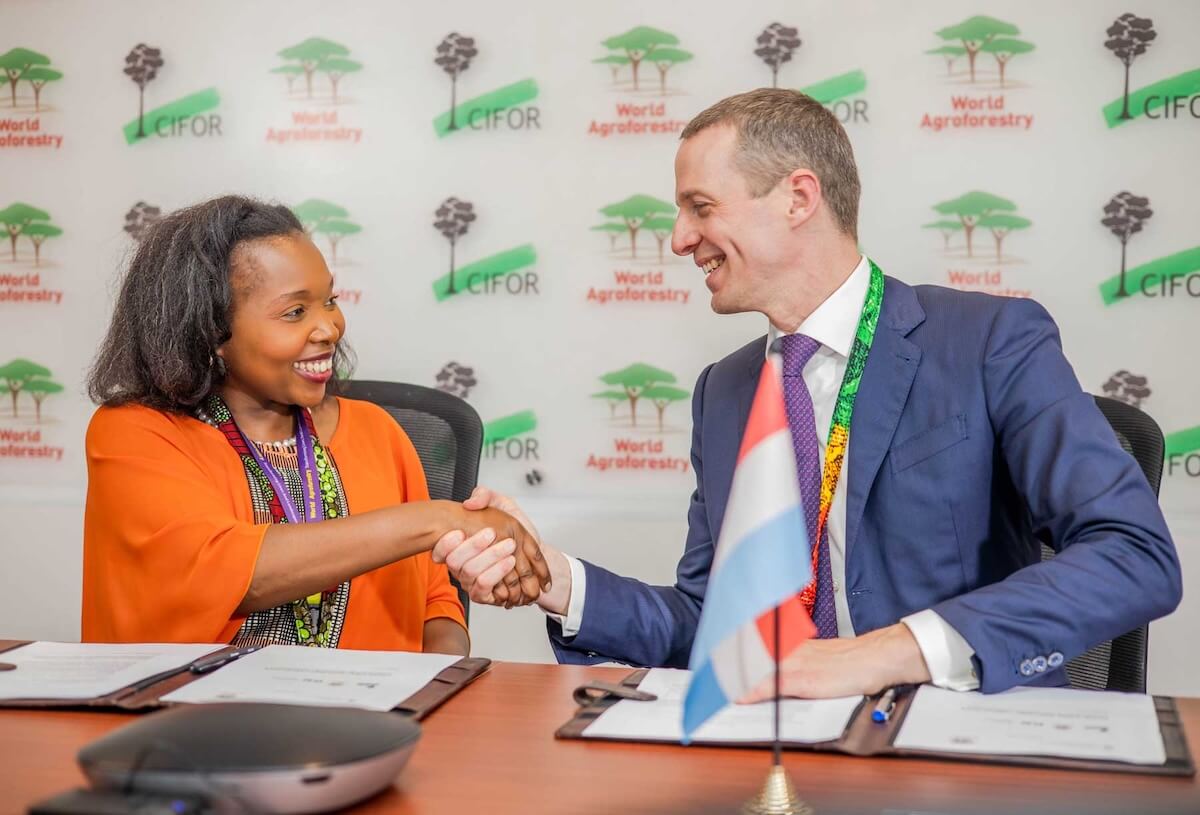
Dr. Éliane Ubalijoro, Chief Executive Officer of the Center for International Forestry Research and World Agroforestry (CIFOR-ICRAF) and Serge Wilmes, Minister of the Environment, Climate and Biodiversity, Grand Duchy of Luxembourg.
Luxembourg and CIFOR-ICRAF are committed to foster synergies between biodiversity and climate by protecting and leveraging nature as the foundation of a sustainable economy,” said Serge Wilmes, Minister of the Environment, Climate and Biodiversity, Grand Duchy of Luxembourg. “Our priorities are focused on advancing science-based environmental solutions that mobilize government, civil society, and the private sector. The need to direct our efforts towards nature-based solutions, and to address the climate and biodiversity crises simultaneously, is becoming more urgent.”
“Science-driven nature-based solutions come to life when the right players understand each other and connect in action with shared values,” said Dr. Éliane Ubalijoro, Chief Executive Officer of the Center for International Forestry Research and World Agroforestry (CIFOR-ICRAF). “Nature needs funding and funding needs knowledge. Such synergies do not come about spontaneously, which is why, together with the Grand Duchy of Luxembourg, CIFOR-ICRAF has established RLL to effectively connect the academic, business, and public spheres.”
In the coming years, the partnership will leverage funding for Nature-based solutions. CIFOR-ICRAF as the world’s leading development organization on terrestrial natural capital research together with Resilient Landscapes, a team of non-scientists within CIFOR-ICRAF, speaking the language of both science and business will contribute with its joint knowledge to the success of the partnership. The catalytic effects of Luxembourg’s expertise in finance and Resilient Landscapes’ expertise in Nature-based solutions will provide an opportunity to push topics such as ‘Business for Biodiversity’ and natural capital accounting.
More specifically, RLL intends to focus on incubating projects that have either emerged from the CIFOR-ICRAF research portfolio or that come from external sources and can benefit from CIFOR-ICRAF’s outstanding research database and network of partners and project activities in over 60 countries.
“As Luxembourg gathers and supports key players of impact investment, cross-player synergies are expected to take place immediately and, after a few years, results to speak for themselves,” said Stephane Perrier, Global Lead, at CIFOR-ICRAF Resilient Landscapes. “Telling project stories backed by hard evidence provided by CIFOR-ICRAF is the most influential tool to advocate for high-quality standards in the NbS sector.”
“The partnership is expected to embed RLL into Luxembourg’s existing suite of strategies, programs, and initiatives. Given the international recognition of Luxembourg’s dynamic impact finance sector and early adoption of sustainable standards for this industry, Luxembourg is in a unique position to contribute to the mission and governance of RLL as it drives quality standards in large-scale long-term NbS investments,” said Georges Gehl, Director of Climate and Sustainable Development at the Ministry of the Environment, Climate and Biodiversity.
“RLL will not only become an impact multiplier for CIFOR-ICRAF but offers a new entry point and an opportunity for CIFOR-ICRAF to ensure that its science and innovation is vastly visible and actionable to the private sector,” said Nevena Bakalar, Partnerships and Engagements Lead at CIFOR-ICRAF Resilient Landscapes.
By substantially contributing to the fight against climate change and biodiversity loss in a synergetic way, Resilient Landscapes Luxembourg (RLL) will also generate other environmental and social co-benefits. RLL environmental, social and governance assessments will be robust and science-based, with clear metrics and impact results to enable the private sector to make real changes for nature and people.
A new initiative seeks to bring public-private collaborators together, to overturn funding hurdles and develop new strategies to address challenges surrounding ecosystem management.
Resilient Landscapes, officially launched at the digital forum Can tree planting save our planet? hosted by CIFOR and World Agroforestry (ICRAF), is an innovative platform designed to leverage the centers’ combined 69 years of research, technology and innovation on integrated forestry and agroforestry systems.
It is also tailored to provide solutions for companies, financial investors, donors and governments to the most complex and urgent global crises – ranging from climate change to biodiversity loss to broken food systems.
The term “nature-based solutions” increasingly reverberates through climate-change lexicon, referring to ways of mitigating its impact by protecting and restoring the natural world. Often, it is broadened out to include using nature to address other complex global challenges, such as alleviating poverty and conserving biodiversity.
Tree-planting might well be the most-heralded nature-based solution of late, with governments, businesses and public figures, from primatologist Jane Goodall to software-maker Salesforce, supporting ambitious planting pledges, such as the blockbuster 1T.org initiative launched earlier this year, which aims to plant and protect 1 trillion trees by 2030.
“We are seeing tree planting growing into a global movement, and a default move in order to restore ecosystem balance and save the planet from the ravages of climate change,” said CIFOR Director-General Robert Nasi at Can tree planting save our planet? hosted by CIFOR and World Agroforestry (ICRAF).
“This is what we want – or at least what I want,” he said. “But the simplistic assumption that if you need to offset your emissions you plant a tree is wrong, and these kinds of practices must change. We should not be interested in planting trees but in growing trees. There is a difference in terms of time and in terms of scale: this is a long-term endeavor.”